|
|
Abkhazia
Legal basis of statehood and sovereignty
Chapter I. Abkhazians - ancient ethnos with original culture
1.1 Ethnos formation
Analysis of the ancient history of the Abkhazian people testifies that this
nation has roots reaching back to the multi-thousand-year past and that
Abkhazians lived in the Western Transcaucasia, more precisely around modern
Abkhazia. From time to time, they occupied territories from the northern
termination of the Caucasian ridge to Trebizond, within the borders of
present-day Turkey, and to Armenia. According to data of historians, formation
of the Abkhazian ethnos began in II - IBC and came to an end in the period from
VII AD to the beginning of VIII AD. The importance of this period is that in
its chronological frameworks it is possible to track the evolution of
ancestors of the Abkhazian people. At the heart of the modern Abkhazian language
lies the parent language which was already used in these places in
III-II BC.
According to historian L.P.Zagursky (1888), a central part of the Caucasian
territory and the western part of Transcaucasia were occupied by groups of
people whose relationship with other people was not known, and Abkhazians
were one of the peoples of the western mountain group. These were: Abkhazians (Azega),
living in the Sukhumi district - 32 thousand people; Abazinians - 10 thousand
people living in the southeast of the Kuban region; Adygs – Circassians,
Kabardians, Abadzekhs, Bzhedukhs, Shapsugs, Besleneevs, speaking one
language, but having two dialects. Total number of Adygs - 130 thousand
people Their language also had no relationship with languages of other nations
of the world. Famous German scientist Freidrich Miller named such people
“independently standing” (isolirte Volkег).
Their ethnogeographical area represented the territory of present Abkhazia
and though in different years Abkhazians occupied the vast regions to the
north and east of this area, it was always their major settlement
from the middle of 1st century BC. By the end of 1st century AD some feudal
pre-Abkhazian princedoms were formed, which for some centuries co-operated with
each other and with neighbouring peoples. As S. Shamba notes, no serious
scientists till now have challenged the fact of connection of the term “Apsua”
with the tribe Apsils, resident in the territory of Abkhazia since I century AD.
Throughout VII-VIII centuries, separate Abkhazian princedoms began to unite,
and this process came to an end with the formation of the Abkhazian nationality
and creation of the complete Abkhazian state. The subsequent history of the
Abkhazian kingdom was closely connected with Byzantium, which stimulated its
blossoming in X century and affected life in the territory until its
great decline in XV century.
XIV-XV centuries are characterised in the history of the territory by a
revival and strengthening of Mediterranean communications. A special role in
these was played by trade between Genoa and the coast of Abkhazia, which left a
deep trace in the local economy, political history and culture. During this
period trade routes were revived connecting the seaside trade centres with
the North Caucasus and the Volga region (Golden Horde). An increase in Turkish
presence from the end of XV century diminished, and this completely interrupted
time-honoured relations with Europe. By the end of XV century, after the capture
of Constantinople by Turks and the decline of the Byzantian empire, the Abkhaz-Imeretian
kingdom broke up, and internal friction among tsars and princes caused mutual
enmity and fratricidal wars. This period was an epoch of the greatest decline in
all spheres of life within isolated parts of the former Abkhazian state. The
XVIII century witnessed the primary influence of the Ottoman empire using
Abkhazia as the main base in a gain of the Western Caucasus.
Abkhazia is the most ancient country in Caucasus to practise orthodox
Christianity. The assimilation of Christianity among the Abkhazian population
had begun during the first centuries AD, and in first half of VI century,
Abkhazians officially accepted Christianity. In coastal and mountain zones
many churches were constructed. From IV to X centuries the Abkhazian church was
administratively subordinated to Byzantium as an Abkhazian catholic see, and
the territory actually Abkhazia acted within the limits of the Abkhazian
kingdom independently - the main temples of X century were under construction
not in the capital of the kingdom (Kutaisi), but nearer to the sea and
Byzantium in a zone between Pitsunda and Bedia. This position continued in XI
century, then for some time the local church depended upon the Alanian
Metropolia and, presumably, the Mtshetsk Catholic see. Wide
communications with Byzantium raised the level of civilisation of the Abkhazian
nation, constantly expanding its influence to almost all of Western
Transcaucasia.
Inscriptions in temples of Abkhazia in Hutsuri2 appeared during a later
time, at the end of existence of the Abkhazian kingdom, when the official Greek
language of Abkhazia began to be replaced with this language of official
establishments. It bears no relation to the
formation of ethnoses, as the Abkhazian ethnos was formed in
the V-III centuries BC in its own territory. Inscriptions contain the
message that these churches are constructed by "THE ABKHAZIAN TSARS”. If
other countries under the rule of the Abkhazian tsars are also mentioned in
inscriptions, Kartli is usually placed after Armenia and Iberia, which
testifies to its minor value. This is contrary to statements of the Georgian
historians of the XX century, who declared that this kingdom, together with
Abkhazia, struggled for the creation of a uniform "Georgian" state.
2 Hutsuri - the alphabet known since V century AD., believed to have
originated from East Aramaic writing. It is used in modern Georgian language.
Within the territory
of Abkhazia, a certain role was played in due time by Catholicism, Judaism and
Islam, in addition to Orthodoxy. Jews lived in local towns during ancient times.
Their communities in the Middle Ages existed in Gagra (XI century) and
Sebastopolis (XIV century). The ancestors of Abkhazians encountered Islam for
the first time at the beginning of VII century.
In the culture and life of the majority of modern Abkhazians, traditions of
Christianity, Islam, pagan beliefs and ancient mountain customs are alive.
Perhaps this land is the best living example of the fact that ethical
doctrines of all religions are not naturally hostile to each other. For example,
Abkhazians who practice Islam also celebrate Easter, and present-day
mountain people still consider the oath at a sacred oak to be indestructible.
Ancient pagan symbols are also found upon the Abkhazian flag. On a red field
the open palm is represented - it holds no weapon, and is the wave of the hand
of a sower throwing grains onto an arable land.
The Abkhazian language together with other closely-related languages
(Abazinian, Adyg and Kabardian, Ubykh, Circassian, Shapsug, etc.) forms
the Abkhazian-Adyg (West Caucasian) group. It is known that language is the
basis of spiritual life of all people. Both science and Abkhazians
and Adygs (Circassians, Kabardians, etc.) themselves have no doubt that these
peoples in the past made a single whole. This is proved to be true by similarity
of language, character, belief, superstitions, customs, way of life, and
traditional dress.
Ancestors of Abkhazians spoke in the different languages and dialects of such
related tribes as Apsils, Abazgs, Sanigs and Misimianians. In the first
centuries AD dialects united to create the Abkhazian language that promoted
formation of the Abkhazian nationality, and to develop folklore and culture as
a whole. Formation of uniform language promoted the association of related
tribes, and creation of the Abkhazian nation in which writing was already known
at that time. The antiquity and high development of the Abkhazian language may
be seen through its influence on the languages of neighbouring nations. With its
help it was possible to interpret many ancient cuneiform inscriptions in
different regions of the world and to explain the writing of some other peoples.
This language, certainly enriched for two thousand years, is used by modern
Abkhazians. It is necessary to underline that neither the Abkhazian language at
the beginning of the Christian era nor modern Abkhazian have anything in
common with the modern language of Georgia, or with the parent languages of
nationalities and tribes earlier occupying the eastern Black Sea coast.
With the coming of Abkhazia under Russian protection in 1810, and later, with
its renaming as the Sukhumi Military Department, direct Russian administrative
power was established in the country. In 1883 the Department was included
in the Kutaisi governorship as a district. The well-known researcher of
territory G.A.Rybinsky in the work “Abkhazia in the agricultural and household
relation” (1894) gave the following data on agricultural population structure
in the Sukhumi district: “besides Abkhazians, other agricultural population
of the district represents a surprising mix of nationalities - Abkhasians - 65
thousand souls, Russian settlers - 800 souls, Estonians - 587, Germans – 288,
Greeks - 2192, Armenians - 688, Mingrelians - 1472 souls”.
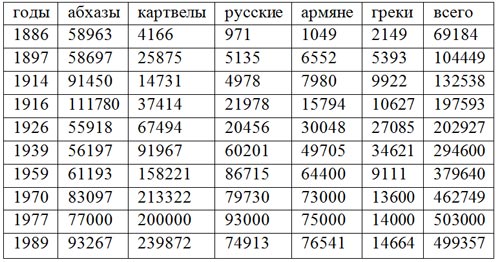
For that period, the results of the population census of 1886 in Abkhazia
should be recognised as the most authentic data. The totals were: Abkhazians –
58,963 persons, Georgians (Mingrelians?) - 4166, Russians - 971, Armenians -
1049 and Greeks - 2149. As for Abkhazians, these are all who remained in the
homeland after their mass exodus during the time of makhadjirstvo.
The main points of reference for a country to the ethnos of indigenous people
occupying it are the results of statistical researches on a population
census in that country. These materials can provide a basis for research into a
demographic situation, and define the ethnic formation of the people in the
territory.
The given statistics for 1886 and the following years, which cannot be
suspected of bias and a juggling of data in the interests of the Abkhazians,
show that in reality Georgians (actually Mingrelians) were almost absent from
the territory of Abkhazia at the end of XVIII century, and only settled
intensively in this territory from the beginning of XIX century (Table 1).
Table 1. Ethno-demographic structure and population of Abkhazia,
using material from the
statistical researches undertaken during the different
periods :
It is also necessary to consider the fact that population reference to this
or that ethnos is defined by the people living in territory belonging to those
people, instead of by appointed or foreign persons, or by high-ranking
organisations, up to and including the United Nations.
According to calculation of the population of the Sukhumi district in 1916,
the number of Abkhazians with Samurzakanians was 111 780 souls or 56 % of all
the population, Kartvels - 37 414 or 18 %, Russians - 21 978 or 11 %,
Armenians - 15 794 or 8 %, remainder of population - 10 627 or 7 %. Divergences
in numbers of Abkhazians and Kartvels in 1897 and 1914 are explained, in our
opinion, by reference to Samurzakanian inhabitants in 1897 not as Abkhazians,
but as Kartvels, which is incorrect.
On the basis of the analysis of materials of censuses it is possible to draw
the following conclusions:
1) results of an official census are legally authentic materials;
2) at the time of the 1886 census, and during the period previous
to it, a mainly Abkhazian population (over 85 %) lived in the territory
of Abkhazia;
3) after 1864 as a result of a colonial policy practised by Russian imperial
administration in Abkhazia, there was uncontrolled settling by peasants -
Mingrelians, Gurians, Kartvels, etc. The settlements had become empty owing to makhadjirstvo,
i.e the departure of Abkhazians from their usual dwelling places. At the same
time, it is possible to assert with confidence that at the beginning of XVIII
century there were very few representatives of other groups of people (Mingrelians,
Kartvels, etc.) living in Abkhazia;
4) all statements from officials and organisations that Abkhazians did not
live in the territory of modern Abkhazia, identical to the Sukhum district
existing at that time, contradict legally confirmed facts, and have by
themselves no legislative grounds and are insignificant;
5) results of census establish the dwelling rights of the Abkhazian people
within the territory of Abkhazia, this ethnos having occupied the territory
since ancient times.
The residence of the Abkhazian people in the given territory since ancient
times is also proved by numerous archaeological materials and historical data.
Shamba T., Neproshin А. Abkhazia: Legal basis of statehood and sovereignty. М: Open Company "In-Oktavo", 2005, 240 pages.
Далее читайте:
Абхазы -
(самоназвание апсуа) автохтонное население Кавказа.
Абхазия
(краткая историческая справка).
Исторические лица Абхазии (биографический справочник).
|
